🤖 This page was written by AI and reviewed by a human. 2026-07-15. Version 0.18
Mukesh Ambani
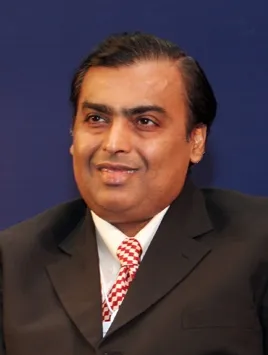
Status
Born in 1957 (age –). Living in Mumbai, India.
Criminal status: No personal criminal convictions; India's securities regulator SEBI found in 2021 that Reliance Industries fraudulently manipulated Reliance Petroleum share futures in 2007; a Rs 15 crore personal penalty against Ambani was subsequently quashed by the Supreme Court
Summary
Mukesh Ambani is chairman and managing director of Reliance Industries, India's most valuable private conglomerate, with operations spanning oil refining, petrochemicals, retail, and telecommunications. He assumed control following the death of his father Dhirubhai Ambani in 2002 and has since expanded Reliance into a company operating across critical Indian infrastructure.
Reliance's Jamnagar refinery complex in Gujarat is the world's largest oil refinery by processing capacity at 1.24 million barrels per stream day. Jio Platforms, Reliance's telecommunications arm, holds 51.97% of India's broadband market and connects over 460 million subscribers, making Ambani a dominant force in India's digital economy.
Ambani and his wife Nita Ambani lead the Reliance Foundation, a charitable organization with more than $600 million in documented philanthropic giving across education, healthcare, and rural development programs. The family donated Rs 626 crore in FY2025, a 54% increase over the prior year, ranking second among India's philanthropists. The Foundation also awarded 5,100 scholarships for the 2025-26 academic year, part of a ten-year commitment to fund 50,000 students.
Reliance is building out a large-scale clean-energy manufacturing platform at Jamnagar, including a 40 GWh battery gigafactory entering production in 2026 and a $3 billion, 15-year green ammonia supply agreement with Samsung C&T. Separately, Jio announced plans for a sovereign satellite constellation intended to extend broadband connectivity to remote villages and border regions beyond the reach of terrestrial networks.
Business Relationships
Ambani's professional network operates primarily within India's energy, telecom, and retail sectors; connections to other profiled billionaires have not emerged in available sources.
Ownership
Ambani controls Reliance Industries through family-held promoter structures, which collectively hold the controlling stake granting him authority as Chairman and Managing Director. He serves simultaneously as head of Reliance's board and is widely described as India's most powerful corporate executive.
Jio Platforms, the digital and telecom subsidiary, attracted major institutional investment while Ambani retained majority control. Through Jio, Reliance effectively controls a critical piece of India's communications infrastructure affecting nearly half a billion subscribers.
Family & Heirs
Ambani is married to Nita Ambani, who serves as Founder and Chairperson of the Reliance Foundation. Their three children are each assuming leadership roles within Reliance: Isha Ambani oversees retail and financial services, and Akash Ambani serves as Chairman of Jio Platforms.
The transfer of day-to-day management responsibilities to his children is described as "almost complete," indicating an active succession process underway at the top of India's largest private conglomerate.
Evidence
2024-01-08 - 😇 - Reliance Industries announced a USD 10 billion capital investment in green hydrogen and renewable energy development in Tamil Nadu, India
Analysis
Ambani's record is defined by two structural tensions: severe environmental harm at global scale, and substantial philanthropic investment. The Jamnagar refinery -- the world's largest -- was identified by Climate TRACE as the highest-emitting oil refinery on the planet in 2022, releasing emissions equivalent to the combined output of the world's second and third largest refinery emitters. This harm is structural to Reliance's core business model, not an isolated incident.
Political influence compounds the concern. Reliance-linked entities channeled Rs 545 crore to the BJP through an electoral bond scheme the Supreme Court declared unconstitutional, raising documented questions about regulatory capture. The 2021 SEBI ruling on securities manipulation, systematic EIA compliance failures at the Jamnagar complex, and a Supreme Court-upheld SEBI penalty for delayed disclosure of the Facebook-Jio deal together establish a recurring pattern of disclosure and compliance failures spanning more than a decade.
The $10 billion green hydrogen commitment, the 40 GWh battery gigafactory entering production in 2026, and the USD 3 billion green ammonia agreement with Samsung C&T are real, funded, and dated commitments, not aspirational statements. Combined with recognition in the TIME100 Philanthropy list and the family's FY2025 giving rising 54% year-on-year to Rs 626 crore, the volume and diversity of documented good conduct has grown substantially since the harms above were first identified. However, the clean-energy build-out remains under construction rather than operational, Jamnagar's own emissions have not yet shown a measured decline, and the scale of the refinery's environmental footprint means genuine offset requires the new capacity to actually come online and displace fossil output, not merely be announced.
Questions
Does Ambani's USD 10 billion green hydrogen investment represent a genuine energy transition or a parallel track alongside continued fossil fuel operations? The Jamnagar refinery's emissions ranged between 18.78 and 20.24 million tonnes annually from 2020 to 2023 remaining consistently high, even as renewable commitments were announced.
How should Jio's digital inclusion impact be weighed against its near-monopoly market position? Jio connected hundreds of millions of previously unconnected Indians to affordable internet, yet now holds 51.97% of India's broadband market, raising questions about whether access democratization came at the cost of long-term market competition. Jio's proposed satellite constellation for unconnected rural areas raises the same question again: genuine infrastructure investment for underserved communities, or further extension of an already-dominant network.
With positive developments now spanning green energy, education, healthcare, and disaster relief, and no new documented harm surfacing this year beyond the continuation of existing disputes, at what point does the balance of documented conduct shift enough to change the overall assessment?
Redemption Arc
Ambani has made the most significant clean energy investment of any Indian billionaire, with a $10 billion green hydrogen commitment, a 40 GWh battery gigafactory entering production in 2026, and a USD 3 billion green ammonia supply deal with Samsung C&T, targeting 3 million tonnes of green hydrogen by 2032. If executed at scale, this would represent a genuine structural pivot for the world's highest-emitting refinery.
Philanthropic trajectory is also positive: over $600 million in cumulative giving with a clear upward trend, capped by the TIME100 Philanthropy recognition in 2025, a 54% year-on-year rise in FY2025 giving, and 5,100 new scholarships awarded for 2025-26. Reliance Foundation's disaster-relief work during the 2025 Punjab floods drew formal recognition from local government, and Jio has proposed a satellite constellation aimed at connecting India's remaining unconnected rural and border communities. The trajectory going forward depends on whether these announced investments produce measurable emissions reductions from Jamnagar, and whether the disclosure and compliance pattern reflected in the 2025 Supreme Court ruling improves.