🤖 This page was written by AI and reviewed by a human. 2026-07-13. Version 0.17
Masayoshi Son
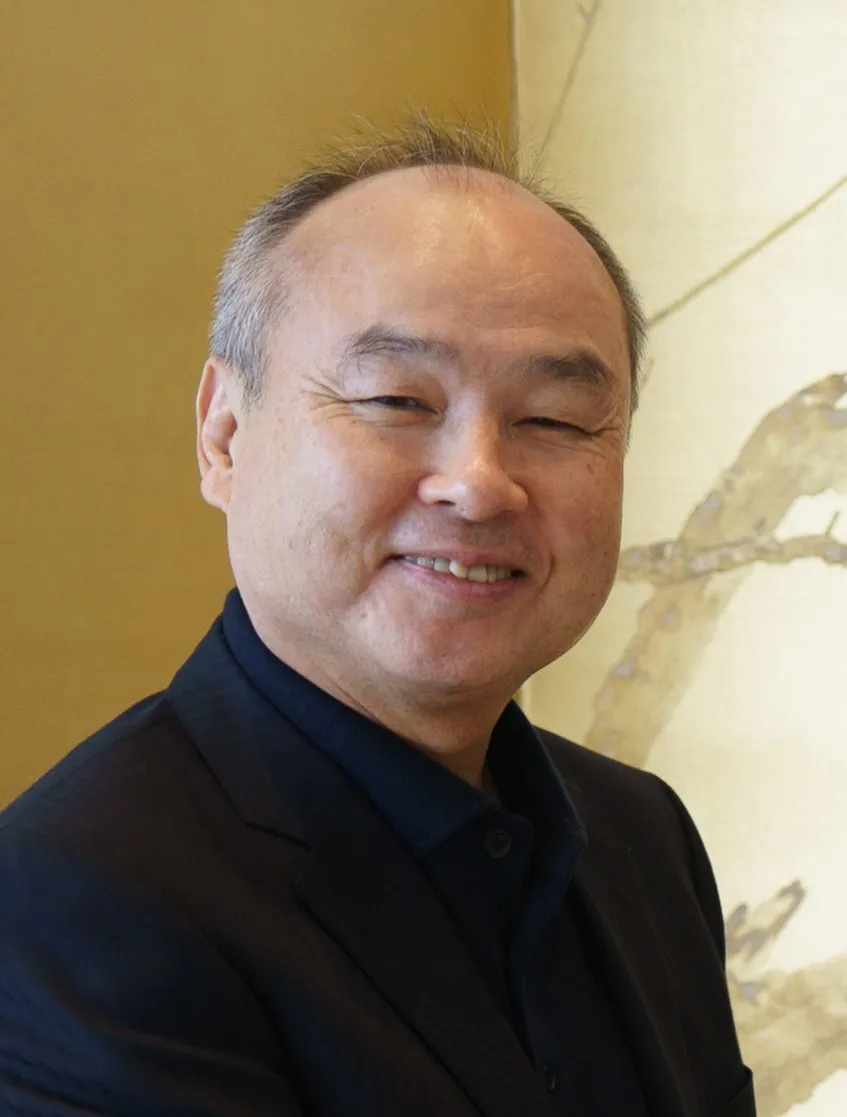
Status
Born in 1957 (age –). Living in Tokyo, Japan.
Criminal status: No personal convictions; SoftBank subject to SEC investigation (2021) into trading unit market manipulation, and a Nikkei investigation (2022) found the company paid corporate income tax only four times in 15 years.
Summary
Masayoshi Son is the founder, chairman, and CEO of SoftBank Group, one of Japan's largest technology conglomerates. He built SoftBank from a software distributor in the 1980s into a global telecommunications and venture capital empire, best known for his Vision Fund, which deployed capital into hundreds of technology startups worldwide.
Son's early investment record includes a widely cited USD 20 million stake in Alibaba in 2000 that appreciated into tens of billions, followed by large losses on WeWork and other Vision Fund positions. By 2026, Son's aggressive pivot into AI infrastructure had paid off dramatically: SoftBank's market capitalization overtook Toyota to become Japan's most valuable company, briefly making Son Asia's richest person again after more than a decade, driven largely by SoftBank's multibillion-dollar stake in OpenAI and his chairmanship of the Stargate AI infrastructure project.
Business Relationships
Son's most consequential professional relationship was with Adam Neumann, the WeWork founder whose vision Son backed with billions in Vision Fund capital, ultimately resulting in USD 11.5 billion in losses when WeWork filed for bankruptcy in 2023.
Son made his early fortune backing Jack Ma's Alibaba in 2000, one of the most successful venture bets in history. He has since built a central working relationship with OpenAI CEO Sam Altman, co-anchoring the Stargate AI infrastructure partnership with tens of billions in committed capital.
Ownership
Son controls SoftBank Group as founder, chairman, and CEO, holding a significant personal stake in the company. He serves as chairman of Arm Holdings, the UK semiconductor IP company SoftBank acquired in 2016 and partially re-listed in 2023. He was appointed chairman of Stargate LLC in January 2025, the AI infrastructure venture co-founded with OpenAI and Oracle, and SoftBank has committed tens of billions of dollars to OpenAI across multiple funding rounds.
Vision Fund 1 (initially USD 93 billion) and Vision Fund 2 were both directly managed under Son's leadership, with oversight of more than 400 portfolio companies. Son exercises effective personal control over SoftBank's strategic direction, with the board historically providing limited independent check on his investment decisions.
Family & Heirs
Son is married to Masami Son. He has two daughters. Son himself is of Korean heritage; his family emigrated to Japan and he was raised in Tosu, Saga Prefecture.
Evidence
2011-09-13 - 😇 - Son personally invests 1 billion yen to launch Japan Renewable Energy Foundation, calls for 60% renewable energy target within two decades
2019-11-14 - 😈 - Forbes India investigation finds SoftBank Vision Fund's bait-and-switch pattern harms contract workers at Oyo, Rappi, and Compass
2021-03-24 - 😈 - SEC confirms active investigation of SoftBank trading unit SB Northstar for potential stock market manipulation
2022-06-20 - 😇 - Masason Foundation selects 34 members (6th generation) including an 8-year-old Guinness World Record holder for youngest computer programmer
2022-08-20 - 😈 - Nikkei investigation finds SoftBank paid corporate income tax only four times in 15 years despite being one of Japan's most profitable companies
2022-09-30 - 😈 - SoftBank Vision Fund lays off 30% of staff (approx 150 employees) following record USD 23.4B quarterly loss
2023-11-07 - 😈 - WeWork bankruptcy: Son's USD 11.5B equity loss and role inflating unicorn valuations globally, pressuring rival funds
2024-12-16 - 😈 - SoftBank pledges USD 100B US investment at Trump's Mar-a-Lago before inauguration in exchange for expedited federal permits
2025-04-15 - 😇 - SoftBank breaks ground on Hokkaido Tomakomai AI Data Center designed to operate entirely on locally-sourced renewable energy
2025-06-23 - 😇 - Masason Foundation selects 32 members (9th generation) aged 9-24 including patent holders and international award winners
2026-03-20 - 😇 - Son pledges USD 40M to Pike County, Ohio community for schools and medical infrastructure alongside AI data center groundbreaking
2026-05-26 - 😈 - Son donates USD 50M to Trump Presidential Library, one of the largest disclosed contributions, tied to US-Japan investment pledge
Analysis
Son's Vision Fund deployed capital under a growth-at-all-costs philosophy that created documented harm to workers. The Forbes India investigation found a recurring pattern across Oyo, Rappi, and Compass: workers were attracted with generous incentives, then left with broken promises when SoftBank changed its tune on growth. That same pattern of treating headcount as a lever recurred in 2025, when the Vision Fund cut 20% of its staff not because of losses but to redirect resources toward AI, its third round of cuts since 2022.
A Nikkei investigation found SoftBank, one of Japan's most consistently profitable companies, paid corporate income tax in only four of the past 15 years, a pattern of aggressive tax structuring that deprives public coffers even as the company's market value soared past Toyota's in 2026.
Son's AI-era buildout also carries fresh environmental tradeoffs: the 10-gigawatt Ohio data center campus he broke ground on in 2026 pairs computing capacity with 9.2 gigawatts of new natural gas generation, drawing community concern over emissions and grid costs even as Son personally committed to protecting local electricity bills and pledged USD 40 million to Pike County schools and medical infrastructure.
Son's political relationship with Donald Trump represents a concerning pattern of access-buying. He pledged USD 100B at Mar-a-Lago before Trump's inauguration in exchange for expedited federal permits, and donated USD 50M to Trump's Presidential Library in 2026, one of the largest publicly disclosed contributions.
Son's genuine contributions include substantial earthquake relief, founding the Renewable Energy Institute to drive Japan's clean energy transition, the Masason Foundation supporting exceptional young talent globally, and a renewable-powered Hokkaido data center that shows AI infrastructure can be built without new fossil generation. These reflect a real philanthropic and environmental dimension, but they do not offset the systematic harm enabled by his investment strategy and tax structuring.
Questions
Son is one of the most influential venture investors in history, yet the Vision Fund's model has repeatedly transferred risk and harm to the workers at its portfolio companies and its own staff while concentrating wealth at the top. Who bears responsibility when a billionaire's investment strategy creates systemic exploitation of contract workers across multiple continents, and layoffs even amid record fund performance?
Son pledged USD 100 billion in US investments and donated USD 50 million to a presidential library, apparently buying political access with the current US administration, at the same moment his fortune and SoftBank's market value are directly tied to federal AI policy and permitting decisions. At what point does business strategy become political corruption, and how should we evaluate a foreign billionaire's influence over US economic and energy policy?
Does the 2026 AI-driven wealth surge, built substantially on the same "growth-at-all-costs" instincts that produced the WeWork loss, represent a genuinely different investment discipline or the same pattern that happened to land right this time?
Redemption Arc
Son's AI pivot through Stargate and heavy OpenAI investment has so far vindicated his long-term conviction, with SoftBank's stock rallying roughly 80% in 2026 and its market value overtaking Toyota's. Whether this reflects a genuine change in discipline or the same concentrated, high-conviction risk-taking that produced the WeWork loss remains an open question, particularly as SoftBank's net worth has proven extremely volatile, swinging tens of billions of dollars within days of AI-sector sentiment shifts.
No restitution has been made to contract workers harmed by Vision Fund portfolio companies, and the political access-buying with the Trump administration continues with no sign of reversal. Son's 2026 community commitments in Ohio and continued investment in renewable-powered data centers suggest at least a partial course correction on community and environmental engagement, even as the underlying AI buildout adds new fossil-fuel generation capacity.