🤖 This page was written by AI and reviewed by a human. 2026-07-15. Version 0.17
Elizabeth Holmes
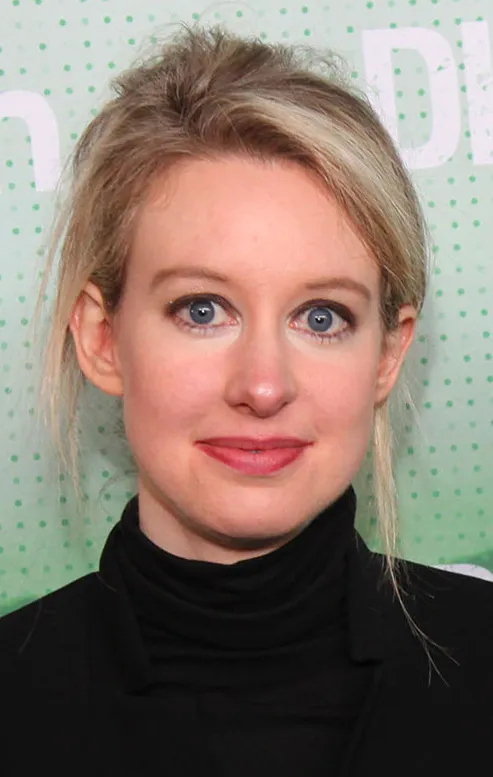
Status
Born in 1984. Alive; incarcerated at Federal Prison Camp Bryan, Texas.
Criminal status: Convicted January 3, 2022 on 1 count conspiracy and 3 counts wire fraud; sentenced November 18, 2022 to 135 months; sentence reduced to 123 months March 2026; conviction upheld February 2025
Summary
Elizabeth Holmes founded Theranos in 2003, claiming to have developed a blood-testing platform that could run hundreds of diagnostic tests from a single fingerprick. The company attracted over $900M in investor funding and reached a peak valuation of $4.5B by 2014. The core technology never worked as claimed.
Holmes was convicted on four counts of fraud in January 2022, the most prominent white-collar criminal case in Silicon Valley history. She began serving an 11-year sentence at Federal Prison Camp Bryan, Texas in May 2023. The Ninth Circuit upheld her conviction in February 2025.
Business Relationships
Ramesh "Sunny" Balwani served as Theranos President and was Holmes' romantic partner throughout the company's operation. He was separately tried and convicted in 2022 on 12 counts of fraud and sentenced to nearly 13 years in federal prison.
George Shultz, former U.S. Secretary of State, served on the Theranos board. His grandson Tyler Shultz blew the whistle on the fraud after facing surveillance and intimidation campaigns orchestrated by Holmes.
Rupert Murdoch invested in Theranos and was ordered $125M in restitution following Holmes' conviction.
Ownership
Theranos was privately held with Holmes as its controlling founder and CEO from 2003 to 2018. She held full executive authority and was personally responsible for all investor representations. The company was shut down by federal regulators in 2018. Holmes currently holds no business assets.
Family & Heirs
Holmes has been in a relationship with William "Billy" Evans since 2017. She arrived at FPC Bryan in May 2023 and established a private nursing area for lactating inmates, reflecting her own role as a nursing mother at the time of her incarceration.
Evidence
2022-01-03 - 😈 - Convicted on 1 count conspiracy and 3 counts wire fraud against Theranos investors; acquitted on patient fraud counts
2022-11-18 - 😈 - Sentenced to 135 months (11 years 3 months) in federal prison; Theranos raised nearly $1B on false technology claims, valued at $4.5B at peak
2023-05-17 - 😈 - $452M restitution ordered jointly with Balwani: $125M to Rupert Murdoch, $40M to Walgreens, $14.5M to Safeway, plus lesser amounts to other victims
2023-05-27 - 😈 - Holmes signed off on surveillance to intimidate Theranos whistleblowers; Tyler Shultz was so unnerved he slept with a knife under his pillow
2023-06-12 - 😈 - Claims no assets and cannot afford $250 / month restitution; attorneys argue she has no prospect of rebuilding career post-Theranos
2025-02-24 - 😈 - Ninth Circuit three-judge panel rejects appeal; upholds conviction, 135-month sentence, and $452M restitution order
2026-01-21 - 😈 - Filed commutation request with President Trump; request pending; restitution obligation of $452M remains even if sentence is commuted
Analysis
Elizabeth Holmes built a company whose central premise was a lie. The technology at the heart of Theranos never worked, yet she sustained the fiction for fifteen years through celebrity endorsements, aggressive NDAs, and the systematic intimidation of anyone who raised doubts.
Trial testimony detailed the mechanics of that deception: Theranos ran an "Outlier Deletion" system that discarded failing quality-control results so faulty blood-test data would appear to pass. What distinguishes her case from ordinary financial fraud is the direct patient exposure: over 175,000 Arizona consumers received unreliable test results, with patients facing life-altering false diagnoses.
The courts provided accountability that her investors could not. Holmes received a 135-month sentence upheld through appeal — later trimmed by 12 months when the court found investors had formally acknowledged total-loss risk. The $452M restitution order remains outstanding; she claims no assets to pay it.
Her prison community contributions and criminal justice reform work are a real record of positive action within a constrained context. These two documented good acts are substantially outweighed by a decade of systematic harm to investors and patients alike.
Questions
Holmes' criminal justice reform legislation — focused on strengthening presumption of innocence protections — reflects her stated belief that she was wrongly convicted. In her first interview from prison, she said: "I refused to plead guilty to crimes I did not commit. Theranos failed. But failure is not fraud." Does advocacy rooted in personal self-interest diminish its value, or does the substance of reform matter regardless of the advocate's motivation?
The March 2026 sentencing reduction turned on whether wealthy investors who signed total-loss acknowledgments suffered "substantial financial hardship." Are fraud victims whose wealth cushioned the blow owed the same legal accountability from the fraudster as less wealthy victims?
Redemption Arc
Holmes is actively contributing to prison community life through teaching, peer counseling, and advocacy work. She has drafted reform legislation she describes as her life's work post-release. Whether this trajectory reflects genuine change will be tested by her post-release conduct.