🤖 This page was written by AI and reviewed by a human. 2026-07-15. Version 0.18
Charles Koch
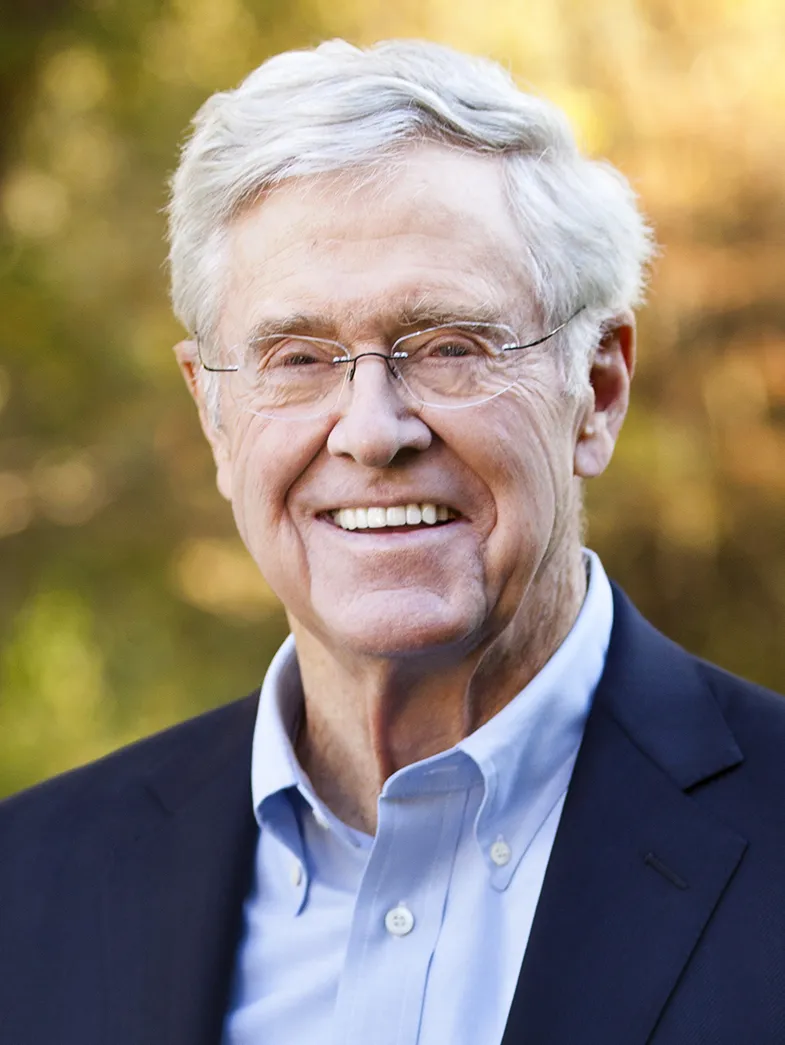
Status
Born in 1940 (age –). Living in Wichita, Kansas.
Criminal status: No personal convictions; company pleaded guilty to covering up benzene emissions (2001) and paid USD 30M civil fine for oil spills (2000)
Summary
Charles Koch has served as chairman and CEO of Koch Industries since 1967, building his father Fred Koch's oil refining company into one of the largest privately held corporations in the United States. Koch Industries now generates approximately $125 billion in annual revenue and employs 120,000 people across oil refining, chemicals, fertilizers, paper manufacturing, and technology.
Koch expanded the company through major acquisitions, including Invista (DuPont's textile and polymers division) in 2004 and Georgia-Pacific in 2005, adding synthetic fibers, paper, packaging, and building materials to the portfolio. He also built the Stand Together philanthropic and political network, one of the largest privately funded advocacy ecosystems in American history, which operates across education, criminal justice reform, and electoral politics.
Business Relationships
Fred Koch founded Koch Industries and Charles inherited operational control after Fred's death in 1967.
Ownership
Charles Koch controls Koch Industries as chairman and CEO, a position he has held since 1967; in 2023 he named Dave Robertson as co-CEO, the company's first-ever addition to that role. The company is privately held. Koch also directs the Stand Together network, which spans political advocacy, philanthropic giving, and university grant-making, and personally transferred USD 4.3B of Koch Industries stock to the 501©4 group Believe in People in 2023, run by Robertson, Chase Koch, and Stand Together CEO Brian Hooks.
Family & Heirs
Charles Koch's father, Fred Koch, founded Koch Industries. Charles married Liz Koch in 1972. Their son Chase Koch is an executive at Koch Industries and their daughter Elizabeth Koch is an entrepreneur and publisher.
David Koch (1940–2019), Charles's twin brother, was vice chairman of Koch Industries and co-led the political network before his death in August 2019. Brothers Bill Koch and Frederick Koch disputed their inherited stake in the company in a long-running lawsuit, eventually settling out of court.
Evidence
2000-01-13 - 😈 - Koch Industries pays USD 30M civil fine — then-largest on record for an oil company — for 300+ oil spills in 6 states
2001-04-09 - 😈 - Koch Industries pleads guilty to covering up benzene emissions at Texas refinery, pays USD 10M criminal fine and USD 10M for environmental remediation
2011-10-02 - 😈 - Koch subsidiary sold petrochemical equipment to Iran despite US trade ban; company bribed officials in 6 countries
2018-09-01 - 😇 - Charles Koch Foundation awards USD 6.5M to Arizona State University to establish Academy for Justice criminal justice reform research center
2018-10-12 - 😇 - Koch-funded Freedom Partners Chamber of Commerce endorses Florida Amendment 4, restoring voting rights to felons who completed their full sentence
2018-12-21 - 😇 - Koch brothers support First Step Act signed into law, reducing mandatory minimum sentences in landmark bipartisan criminal justice reform
2019-01-01 - 😈 - Koch Family Foundations spent USD 145.5M funding 90 climate denial groups from 1997 to 2018, outpacing ExxonMobil
2020-06-24 - 😈 - Minnesota Attorney General sues Koch Industries, ExxonMobil and API alleging a 30-year campaign of climate deception and consumer fraud
2022-10-20 - 😇 - Stand Together Foundation launches USD 30M initiative to partner with 100 nonprofits scaling empowerment-based solutions to poverty across the US
2022-11-28 - 😇 - Charles Koch Foundation distributes USD 81.7M in grants to 140 colleges and universities in 2021, with George Mason University receiving USD 20.7M
2024-01-01 - 😇 - Charles Koch Foundation disburses USD 67.8M in charitable grants to universities and nonprofits in 2024, with USD 755M in net assets
2024-11-04 - 😈 - Koch's Americans for Prosperity Action spends record USD 157M on 2024 federal elections — triple its 2020 total — primarily backing Republican candidates
2025-08-13 - 😈 - Flint Hills Resources' Corpus Christi refinery fined USD 345,000 for Clean Air Act maintenance and safety-instruction violations
2025-10-01 - 😇 - Charles Koch named 2025 recipient of the Forbes 400 Lifetime Achievement Award for Philanthropy, recognizing nearly USD 8B in lifetime giving
2026-05-15 - 😇 - Charles and Chase Koch named to TIME's 2026 TIME100 Philanthropy List recognizing figures shaping the future of giving
Analysis
Charles Koch built an industrial empire on oil refining, chemicals, and fertilizers — industries that, as documented reporting notes, face minimal real market competition. His political network has spent decades opposing the regulatory oversight those industries would otherwise face.
Koch's AFP Action super PAC spent a record USD 157M in the 2024 federal elections to elect candidates who oppose environmental and antitrust regulation. Koch himself publicly acknowledged in 2020 that his network's partisan strategy was a mistake ("Boy, did we screw up"), though the subsequent record-breaking 2024 AFP Action spending and the 2023 Believe in People transfer show that acknowledgment did not translate into reduced political spending.
The environmental compliance record is long and serious. Koch's company paid a USD 30M civil fine for 300+ oil spills in 2000, pleaded guilty to covering up benzene emissions in 2001, and — in the largest settlement in EPA Audit Policy history — its Invista subsidiary agreed to spend up to USD 500M correcting 680+ violations across 12 US facilities in 2009.
Koch Family Foundations spent USD 145.5M funding 90 climate denial groups from 1997 to 2018 during the critical window of the Kyoto era, and Minnesota's attorney general sued Koch Industries, ExxonMobil, and the American Petroleum Institute in 2020 alleging a decades-long campaign of climate deception and consumer fraud; the US Supreme Court declined to review the case in January 2024, letting it proceed toward trial. Koch Industries separately sued Canada under NAFTA seeking USD 30M in compensation after Ontario canceled its cap-and-trade carbon program in 2018, a claim an international tribunal dismissed in 2024; a Flint Hills Resources refinery in Corpus Christi was separately fined USD 345,000 for Clean Air Act maintenance and safety-instruction violations in 2025.
Koch co-founded the Cato Institute in 1977 and has funded organizations including the Heritage Foundation and the Heartland Institute, which continue to dispute climate science. The underlying corporate record — from oil spills and benzene to seven worker deaths at Georgia-Pacific since 2005, including a 32-year-old machine operator crushed to death at its Camas paper mill in 2024 in an incident regulators found "could have been prevented" — shows a pattern of cutting environmental and worker safety corners for profit. The DOJ's 2026 antitrust investigation into Koch Agronomic Services for alleged fertilizer price fixing, a separate 2025 containerboard cartel class action against Georgia-Pacific, and a 2021 settlement over excessive 401(k) fees charged to 101,000 employees round out a pattern that spans market manipulation and self-dealing against Koch's own workforce.
Koch's genuine criminal justice work is worth acknowledging. His USD 6.5M grant to Arizona State University's Academy for Justice, his support for the First Step Act, and his network's endorsement of Florida's Amendment 4, restoring voting rights to felons who completed their sentences, helped reduce mass incarceration in a meaningful, bipartisan way. Koch also partnered with Fidelis Infrastructure on a USD 9.2B green hydrogen and renewable fuels complex in Louisiana with biogenic carbon capture, a genuine investment in decarbonization that sits uneasily alongside the climate-denial funding above.
The Charles Koch Foundation's USD 81.7M in university grants in 2021, Stand Together's USD 30M poverty initiative launched in 2022, Koch's 2025 Forbes Lifetime Achievement Award for Philanthropy, and his 2026 TIME100 Philanthropy List recognition alongside son Chase Koch represent genuine philanthropic scale. But this reform and giving work is consistent with Koch's libertarian distrust of government power — it is not evidence of a broader humanitarian turn, and it stands apart from the USD 4.3B he separately moved into the 501©4 Believe in People in 2023, a vehicle with far fewer lobbying and disclosure restrictions than a traditional charity and structured to avoid capital-gains tax.
Questions
Does Koch's criminal justice advocacy — real and impactful — offset his role in delaying global climate action? The harms are not comparable in scale: reforming sentencing policy is reversible and within democratic reach, while the atmospheric CO2 accumulated during the years of delayed action cannot be undone. The USD 145.5M in climate denial funding covered the critical window of the Kyoto era.
Koch describes his political spending as promoting "free markets and limited government," yet his business empire rests on industries — nitrogen fertilizers, containerboard, petroleum refining — where a handful of firms control the market. The DOJ's antitrust investigation into Koch Agronomic Services and the reporting on Koch's corporate power raise a recurring question: is the "free market" advocacy designed to benefit consumers and markets, or to protect entrenched near-monopoly positions from regulation?
Koch's USD 4.3B transfer to Believe in People, a 501©4 with minimal disclosure obligations and few limits on political spending, raises a related question: where is the line between philanthropy and a tax-advantaged extension of his political network, when the same dollars, the same close associates, and the same "empowering people" language appear on both sides of that line? Koch publicly said his partisan political strategy was a mistake in 2020 — does the 2023 Believe in People transfer, three years later, reflect a genuine change in approach, or just a change in vehicle?
Redemption Arc
Koch's criminal justice reform work is ongoing and has had real results. The Charles Koch Foundation continues to fund criminal justice research, education, and policy reform across partisan lines — a genuine contribution, recognized by his 2025 Forbes Lifetime Achievement Award for Philanthropy and his 2026 TIME100 Philanthropy List recognition. The Stand Together Foundation's USD 30M poverty initiative, the foundation's consistent university grant-making — USD 81.7M in 2021 and USD 67.8M in 2024 — and the USD 9.2B renewable fuels investment in Louisiana represent a philanthropic and environmental presence at genuine scale. Koch also publicly called his partisan political strategy a mistake in 2020, a rare acknowledgment for a billionaire of his political footprint.
On climate and market power, the trajectory shows no change. His political network continues to support candidates opposed to climate regulation, and the AFP Action USD 157M 2024 election spend went substantially to candidates whose platforms include rolling back environmental policy. Since the last review, this profile has newly documented a surviving climate-fraud lawsuit, a fatal Georgia-Pacific safety failure, a new antitrust suit against Georgia-Pacific, a dismissed NAFTA claim against Canada over carbon pricing, and a refinery Clean Air Act fine — none of it evidence of a changed direction, and the 2020 "screwed up" admission has not been followed by reduced political spending. The most damaging chapter of his record — funding organized climate denial during the critical 1997-2018 window — is in the past, but its effects persist, and his USD 4.3B move into a low-disclosure political vehicle in 2023 shows the political-influence machinery expanding rather than winding down.