🤖 This page was written by AI and reviewed by a human. 2026-07-15. Version 0.17
Aliko Dangote
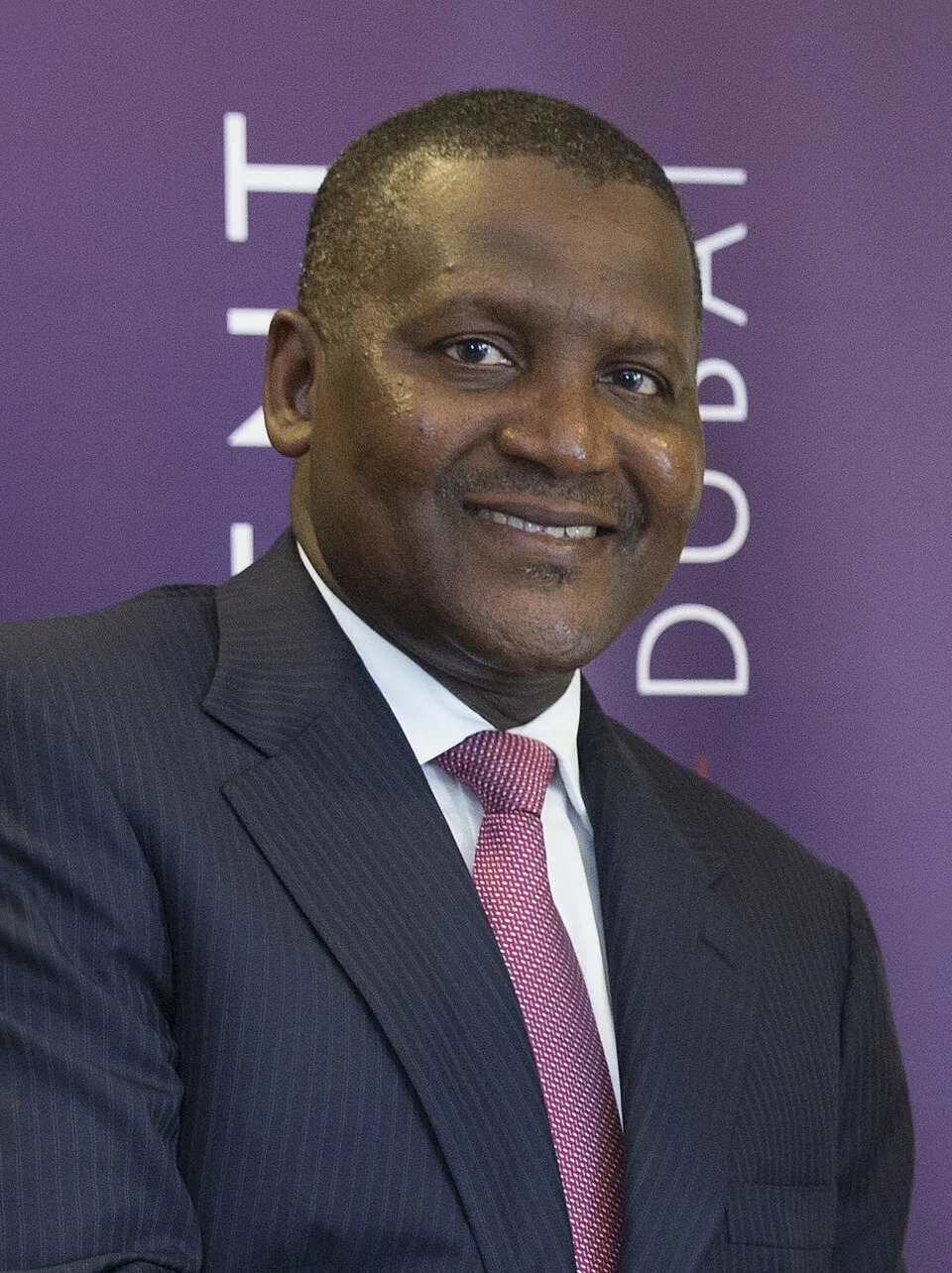
Status
Born in 1957 (age –). Living in Lagos, Nigeria.
Criminal status: No personal convictions
Summary
Aliko Dangote founded the Dangote Group in 1977 as a commodities trading firm in Kano and built it into West Africa's largest industrial conglomerate. He chairs Dangote Cement, Africa's largest cement producer, which operates across ten African countries with an annual capacity of 48.6 million metric tons.
His Dangote Petroleum Refinery, developed at a cost of roughly USD 20 billion, began crude oil processing in early 2024 and by 2026 was supplying close to 80 percent of Nigeria's daily petrol consumption. In July 2026, he confirmed plans for a USD 17 billion, 700,000-barrel-per-day refinery in Lamu, Kenya, and unveiled a multi-billion-dollar power, fertilizer, and port investment plan in Tanzania. As of 2026, he is the wealthiest person on the African continent.
Business Relationships
Since 2013, Dangote has maintained a documented partnership with the Bill & Melinda Gates Foundation for polio eradication and routine immunization across northern Nigeria. Bill Gates joined Dangote for a joint public commitment in Sokoto State in 2018, with the two pledging coordinated support for vaccination programs in six states.
Ownership
Dangote controls his business empire through Dangote Industries Limited, his privately held holding company. He owns approximately 85% of Dangote Cement, which is publicly traded on the Nigerian Exchange Group. Through Dangote Industries, he also controls the Dangote Petroleum Refinery & Petrochemicals, Dangote Fertiliser, and Dangote Sugar.
His refinery targets 650,000 barrels per day and a planned expansion is projected to reach 1.4 million barrels per day by 2028, which would make it one of the largest refinery complexes in the world.
Family & Heirs
Dangote is divorced and has three daughters: Halima, Fatima, and Mariya. In February 2026, he appointed all three to senior executive roles in the Dangote Group as part of a succession planning effort.
Halima was appointed Group Executive Director of the Family Office and International Offices in Dubai and London, Fatima to lead commercial activities in oil and gas, and Mariya to lead cement and food enterprises.
Evidence
2018-04-09 - 😇 - Bill Gates and Aliko Dangote publicly commit to polio eradication and routine immunization in northern Nigeria
2020-05-26 - 😈 - Dangote Refinery violated Nigeria's COVID-19 lockdown; construction continued as at least two workers died from coronavirus
2021-02-16 - 😇 - Dangote Foundation disburses N3.9 billion in micro-grants to 392,490 women and youths across 11 Nigerian states
2023-01-31 - 😈 - Investigation: Dangote Coal Mines violated Nigerian mining laws, polluting and endangering communities in Benue State
2024-02-12 - 😈 - Hazards, maltreatment and human rights violations documented at Dangote Refinery construction site
2024-07-18 - 😈 - Environmental crisis hits Benue communities hosting Dangote Cement; water and land pollution documented
2024-07-29 - 😈 - FIJ investigation: Dangote Refinery construction toll includes 20 company-admitted fatalities, 49 medical treatment cases, and 21 lost-time injuries
2025-05-12 - 😇 - Dangote pledges N15 billion to Aliko Dangote University of Science and Technology for engineering labs and campus infrastructure
2025-09-07 - 😈 - Nigeria Labour Congress issues ultimatum over Dangote Group's anti-labour practices, union-busting, and low wages
2025-09-25 - 😈 - Dangote Refinery sacks 800 workers the day after they join PENGASSAN union, drawing nationwide labor condemnation
2025-12-11 - 😇 - Dangote unveils N1 trillion scholarship scheme funding 1.3 million Nigerian students across all 774 local government areas over 10 years
2025-12-12 - 😇 - Dangote formally pledges 25 percent of his fortune to the Aliko Dangote Foundation, one of Africa's largest individual philanthropic commitments
Analysis
Aliko Dangote's record reflects an industrial ambition that has genuinely reshaped Africa's economy while inflicting documented harm on the workers and communities powering it. His Dangote Group represents decades of effort to break Africa's dependency on imported cement, refined fuel, and food commodities. His Aliko Dangote Foundation has made verifiable philanthropic contributions at increasing scale, from helping eliminate polio in Nigeria to a N1 trillion scholarship scheme reaching 1.3 million students across every local government area in the country.
The labor record runs in the opposite direction. An investigation into the refinery's construction found the company itself admitted to 20 worker fatalities, 49 medical treatment cases, and 21 lost-time injuries. The mass dismissal of 800 workers the day after they joined a union and the NLC's formal denunciations of anti-labour practices point to systemic choices, not isolated failures.
Mining operations in Benue State violated Nigerian law and his cement plants have generated severe environmental damage in host communities, including water contamination and crop failure. Separately, Dangote threatened a Kaduna businessman with a N100 billion defamation lawsuit after the man questioned the source of his wealth on television, and the businessman publicly retracted his remarks within days of the legal threat. The people who gained least from the industrial wealth are often the ones who bore the most direct cost, while public criticism of Dangote himself carries its own legal risk.
Questions
To what extent did government tax exemptions and political connections enable Dangote's market dominance, and should those advantages change how his business achievements are assessed? Nigeria's state oil company has formally accused the Dangote Refinery in court of seeking to monopolize the country's fuel market by challenging rival import licenses, a dispute that remained unresolved as of mid-2026.
Does the scale of his philanthropic giving change the moral calculus around documented labor rights violations and worker deaths? The workers who died or were dismissed for union membership and the communities living with polluted water are not the same people receiving Foundation grants.
Does using a nine-figure defamation threat to extract a public retraction from an individual critic raise different concerns than a company defending itself against a competitor in court?
Redemption Arc
The N1 trillion scholarship scheme, the formal 25 percent wealth pledge, and expanding Foundation programs represent a meaningful, accelerating philanthropic commitment. Against that, the confirmation of a company-admitted death toll at the refinery, the continuation of union disputes into 2026, and a new defamation threat against a public critic show that labor and public-accountability practices have not improved alongside the charitable profile.
In April 2026, the refinery recalled roughly 800 previously dismissed engineers under what management called a "conditional pardon," while warning of renewed sanctions for any future union-related "misconduct" -- a partial reversal that left the underlying anti-union stance in place. The pattern -- generous and growing philanthropy, serious and now more severe labor violations, unresolved environmental damage, and new legal pressure on a critic -- has persisted and, on the labor and public-accountability fronts, has intensified.